
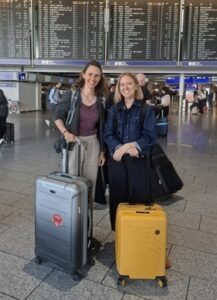
Two weeks, five cities and numerous new contacts: during their NanoporeSCan trip across Canada, Sinja Bächtle and Caitlin Turney introduced nanodiag BW to the Canadian research community and established new connections for future collaborations. At the nanodiag Colloquium in September, the two scientists shared their experiences from the trip and the many encounters along the way.
From Montréal via Ottawa, Toronto and Waterloo to Vancouver: over the course of two weeks, Sinja Bächtle and Caitlin Turney visited research groups, laboratories and companies whose work has numerous links to the research topics of nanodiag BW. Their discussions focused on nanopore technology and molecular diagnostics as well as related research fields such as microfluidics, point-of-care diagnostics, proteomics and optical single-molecule techniques.
The trip was part of NanoporeSCan, funded through the BMFTR initiative ‘Research with North America’. Its aim is to establish contacts for new research collaborations, identify complementary expertise and expand the international network of nanodiag BW.
From Montréal to Vancouver
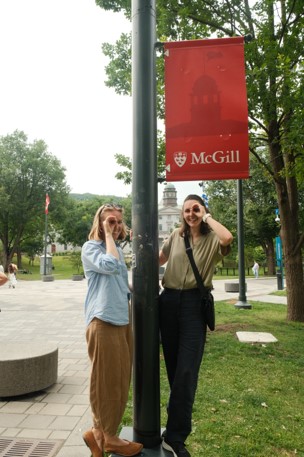
The first stop was Montréal. There, the two ambassadors, both based at Hahn-Schickard, met Teodor Veres from the National Research Council Canada (NRC), among others. His research in microfluidics and point-of-care diagnostics has clear links to work being conducted within the cluster. Further visits took them to the groups of David Juncker at McGill University, Rikard Blunck at Université de Montréal and Raphael Trouillon at Polytechnique Montréal. Their research covers topics ranging from microfluidic systems and biosensors to ion channels and electrophysiology.
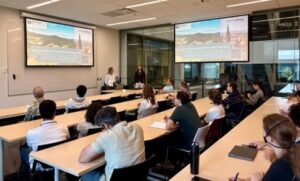
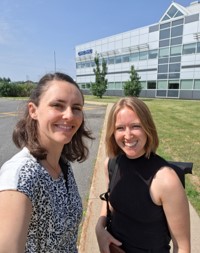
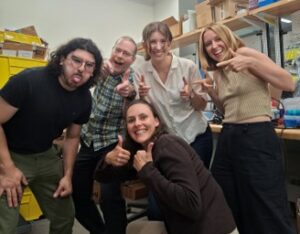
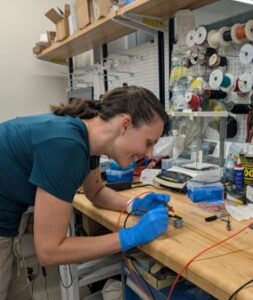
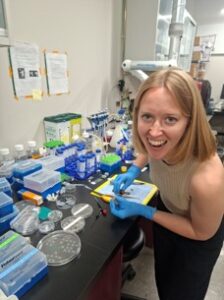
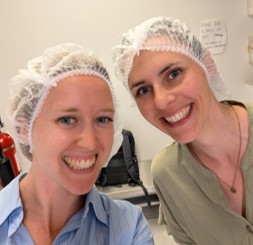
In Ottawa, the itinerary included visits to Vincent Tabard-Cossa and Michel Godin’s laboratory at the University of Ottawa. The visit provided an opportunity to strengthen the already well-established links with Tabard-Cossa and discuss further possibilities for collaboration. One such opportunity could involve Godin’s group, which combines solid-state nanopores with microfluidics and also expressed an interest in scientific exchange. The Ottawa programme also included a visit to Maxim Berezovski, whose research encompasses aptamers, automated selection methods and the analysis of biomolecular interactions.
Further stops included Aaron Wheeler and the CRAFT Facility at the University of Toronto, Clayton Moore from Rapid Novor/EasyM and Carolyn Ren at the University of Waterloo. The exchange with Ren, in particular, opened up concrete prospects for future collaboration. Her research in microfluidics complements expertise within the cluster, and a research stay at Hahn-Schickard as well as a student exchange are being discussed for 2027.
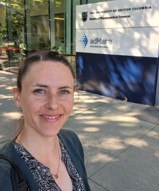
The final stop was Vancouver, with visits to Shyh-Dar Li and Sabrina Leslie at the University of British Columbia. Li’s research on lipid nanoparticles and extracellular vesicles, as well as Leslie’s work on single-molecule imaging, revealed further links to research topics within the cluster.
“I consider this kind of interaction with researchers from related disciplines extremely valuable, as it allowed us to gain a much deeper understanding of the work being done by the other groups than we would have, for example, from a brief conversation at a conference. It also enabled us to make a lasting impression and lay the foundations for further exchange and collaboration.”
Sinja Bächtle, Hahn-Schickard
More than an exchange of business cards
The personal nature of the trip proved particularly valuable for Turney and Bächtle. Unlike brief encounters at large conferences, the laboratory visits provided time to explore research approaches in detail, identify common ground and discuss potential collaborations directly with the respective groups. Many of the researchers they visited showed great interest in the work of nanodiag BW and were open to further exchange.
"I was particularly impressed by how warmly we were welcomed everywhere and by the strong interest in nanodiag BW and our research topics. Above all, it was clear that our Canadian partners are genuinely keen to collaborate with Germany, and that they see us as natural partners at a time when international scientific cooperation matters more than ever. These connections open up real opportunities to extend our network beyond Germany."
Caitlin Turney, Hahn-Schickard
This is precisely where the long-term value of the trip lies: the connections have been made – the next step is to develop them into joint project ideas and research collaborations. This was also one of Bächtle and Turney’s conclusions at the Colloquium: turning these new connections into lasting partnerships will require continued engagement, concrete project ideas and suitable funding opportunities. Sinja and Caitlin are happy to help anyone looking to establish contacts in Canada!
NanoporeSCan is funded through the BMFTR initiative ‘Research with North America’.